You’ve done
the hard part.
The capital is the part nobody helps with.
Four weeks that find exactly what stands between your business and its next round of funding, do the work to fix it, and put you in a room with the financiers who back businesses like yours.
- 2–27 November 2026
- Kigali & online
- 30 ventures
- 5 external seats
- Application Closes
- 16 October, 2026
Two years.
Forty investor meetings.
No cheque.
If that is roughly your story, the problem is probably not your business.
You are in market. You have customers who come back and revenue you can point at. You have survived things that would have closed most companies. And every conversation about funding ends the same way — a polite no, or no conversation at all.
Nobody tells you why. Investors are not obliged to explain, and mostly they don’t. So you adjust the deck, you try again, and another quarter goes.

Here is what is usually happening
You are knocking on the wrong door.
~600
companies a venture partner sees in a year
4
they invest in
1
has to return the entire fund
50–100×
which is what that one has to become
That arithmetic is the whole of it. A venture fund cannot back a good business; it can only back a business that might become enormous, because nineteen of its twenty bets will fail and the fund still has to return money to its own investors.
A business growing 30% a year with healthy margins and customers who come back is an excellent business. It is not a venture capital business.
Both of those are true at the same time, and almost nobody says the second half out loud. So founders with sound companies spend years pitching the one kind of investor who was never going to say yes — while the financiers who would have said yes never hear from them.
The part no one walks you through
There are eleven kinds of capital.
You have been told about one.
Each one wants different evidence, from a different kind of counterparty. Preparing for one is not preparing for another. Click through and find the door that is actually yours.
01
Equity investment
What it is
You sell shares in the company. The investor only makes a return when the business is sold or listed, which is why they care so much about how big it could get.
Who it fits
Ventures with a credible path to being worth fifty to a hundred times more within a decade, in a large market.
What it will ask you to prove
Growth rate, retention, a market sized from your own data, and unit economics that improve with scale.
02
SAFE or convertible note
What it is
Money now, shares later at your next priced round — usually at a discount or a cap, so the price is settled once the business is easier to value.
Who it fits
Earlier rounds where pricing the company today would be guesswork.
What it will ask you to prove
A clean cap table and an honest model of what several notes converting at once will cost you.
03
Mezzanine / quasi-equity
What it is
A hybrid: debt with equity-like features, or repayment linked to how the business performs.
Who it fits
Profitable businesses too large for an ordinary bank facility and too steady for venture capital.
What it will ask you to prove
Two to three years of reliable profit, and a forecast that holds up when someone pushes on it.
04
Venture debt / term loan
What it is
A loan repaid on a schedule with interest. Your ownership stays exactly where it is.
Who it fits
Ventures with cash flow that can service repayment — often alongside or after an equity round, to extend runway without further dilution.
What it will ask you to prove
Consistent cash flow, a clean repayment history, and sometimes security.
05
Working capital facility
What it is
Short-term borrowing against money you are already owed, or against stock you are holding.
Who it fits
Businesses whose constraint is cash timing rather than growth capital — invoiced but not yet paid.
What it will ask you to prove
An ageing receivables schedule, customer concentration, and a real collections history.
06
Trade & export finance
What it is
Financing against confirmed export orders, purchase orders and letters of credit.
Who it fits
Exporters with orders in hand and no cash to fulfil them, and ventures moving into cross-border markets.
What it will ask you to prove
Signed orders, a creditworthy buyer, and compliance with the destination market’s requirements.
07
Asset finance / leasing
What it is
Borrowing secured against the equipment, vehicles or plant itself.
Who it fits
Manufacturing, logistics and agri-processing — anywhere growth needs a physical asset rather than working capital.
What it will ask you to prove
A quotation for the asset, its expected productive life, and what it adds to output.
08
Revenue-based financing
What it is
Repaid as a fixed share of monthly revenue until an agreed multiple is reached. A slow month costs you less rather than breaking you.
Who it fits
Businesses with predictable recurring revenue that would rather not sell equity and cannot carry a fixed repayment.
What it will ask you to prove
Twelve to twenty-four months of monthly revenue records, and low churn.
09
Grants & catalytic capital
What it is
Foundation, competition and development-agency funding. You give up no ownership at all.
Who it fits
Ventures proving a model, opening an underserved market, or doing work with a public good that markets do not yet price.
What it will ask you to prove
Measured outcomes, a theory of change, and the reporting capacity to keep the money.
10
Blended & impact capital
What it is
Investors accepting a lower financial return in exchange for measurable social or environmental outcomes.
Who it fits
Ventures with real impact alongside commercial returns — frequently the ones told, wrongly, that they are not investable.
What it will ask you to prove
Impact measured with the same rigour as revenue, and a commercial model that stands on its own.
11
Strategic / corporate
What it is
A larger company in your sector invests, usually alongside a commercial relationship — distribution, supply or licensing.
Who it fits
Ventures whose product complements a corporate’s distribution, supply chain or customer base.
What it will ask you to prove
A commercial pilot that worked, and clarity on what you will not give away.
Most ventures are matched to more than one — catalytic capital for one workstream and a facility for another, or asset finance before an equity round so the round is not spent on machinery. Part of the work is sequencing them.
What actually happens
Four weeks.
In this order.
Week One
Diagnose
A full readiness diagnostic across strategy, traction, unit economics, financials, governance, team and narrative — and which of the eleven pathways is yours. You leave week one with a written gap list specific to your venture, not a syllabus.
Week Two
Strengthen
Specialists on exactly the gaps we found. Financial modelling, unit economics, legal and governance, growth strategy. No two ventures in the cohort follow the same week.
Week Three
Prepare
Financial model, data room, metrics pack and investment narrative built to diligence standard — then taken apart in a mock investment committee before a real one gets the chance.
Week Four
Connect
Investor Sit-Down Day. One-to-one meetings with financiers matched to your sector, your stage, your cheque size and your pathway.
What you keep
Nine things you walk out with,
whether or not anyone invests.
A written readiness diagnostic
Scored across seven dimensions, with a named gap list. The document nobody has ever handed you about your own business.
A capital strategy
Which of the eleven pathways fits, why, and what evidence it demands of you.
A financial model
Built with visible, defensible assumptions that survive being interrogated.
A metrics pack
Your numbers organised the way a financier reads them, not the way your accounting software exports them.
A data room
Corporate documents, financials, contracts, IP, team and metrics, in one place, ready to share.
An investment narrative
Pressure-tested in a mock investment committee that is deliberately harder than the real one.
A six-month raise plan
Named targets, in sequence, with what to do when each one answers.
At least three matched meetings
One-to-one, with financiers whose mandate genuinely fits your venture.
Six months of follow-up
We track your funnel after the programme ends and keep working the introductions.
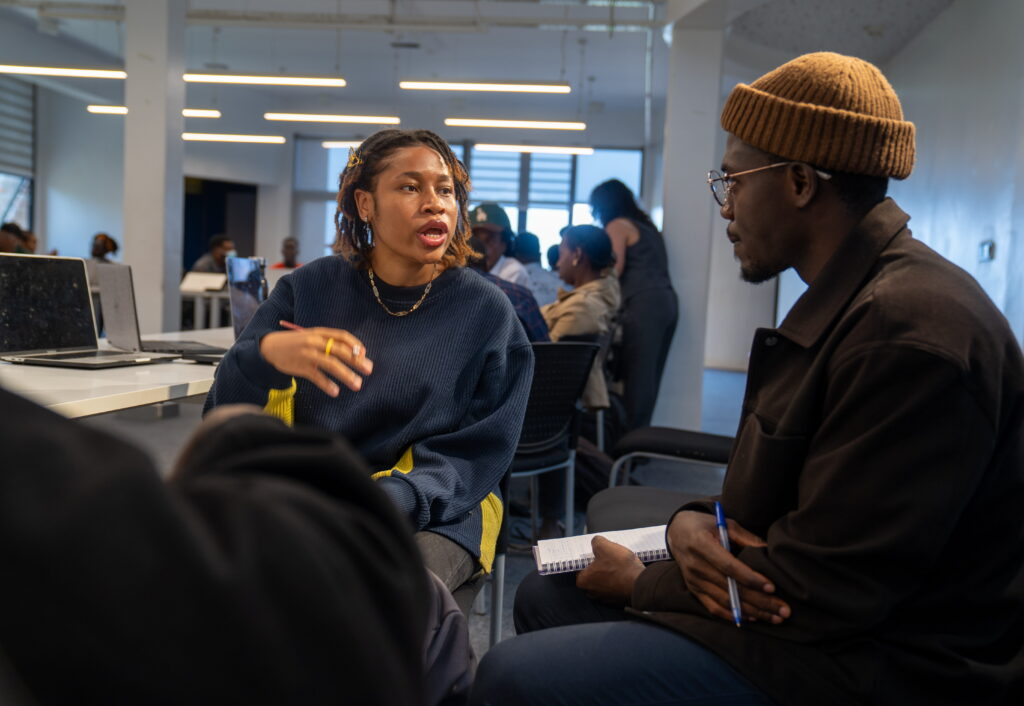
Thursday 26 November
Investor Sit-Down Day
Ten to fourteen financiers. At least eight of them meeting the cohort for the first time on the day — because a room of people who already coached you tests nothing.
The room is assembled after we know what the cohort needs, which is why it is deliberately not a room of venture funds. It is built in tracks: growth and patient capital, angel networks and syndicates, SME financiers and debt providers, trade and export finance institutions, impact and blended capital, and strategic corporate investors alongside the venture funds.
Each financier tells us their mandate before they are invited. We match on sector, stage, cheque size and pathway, and introduce nothing outside that. Your materials reach them ten days early, so the meeting starts from evidence instead of introductions.
Thirty minutes each. A working conversation, not a demo-day stage.
Be honest about
whether this is you.
This is built for you if
- You have been selling to customers for two years or more
- You have revenue, and customers who come back
- You are raising now, or will be within six months
- You can name what the money would buy
- You can give it 8–10 hours a week for four weeks
Don’t apply if
- You are pre-launch, or still validating the idea
- Your revenue is grant income rather than customers
- You want funding but have no use of funds in mind
- November is already full
- You want a certificate more than a diagnosis
We would rather turn you down in September than take your money and waste your November. If you are close but not certain, apply anyway — we will tell you plainly, and tell you what would make next year’s application strong.
What we do not promise
We guarantee three meetings with financiers matched to your sector and stage, a written diagnostic, and materials that survive diligence.
We do not guarantee investment, and you should be sceptical of anyone who does. A growth-stage round in African markets takes six to twelve months from first meeting to money in the bank. An investor can be genuinely interested in November and not wire until July.
That is exactly why we track every venture for six months afterwards instead of declaring a result in December — and why the diagnostic and the materials are yours to keep either way.
Five external seats
$800 for the founding cohort.
Or $400 on acceptance and $400 before week three.
The 2027 rate will be $1,500–2,000. This is the founding-cohort price and it holds for this cohort only.
This is built for you if
- Four weeks of expert facilitation
- The mock investment committee
- Your individual readiness diagnostic
- Investor matching and Sit-Down Day
- Financial model and data-room build
- Six months of follow-up tracking
The application takes about 25 minutes and asks for real numbers. That is deliberate — it is the first half of the diagnosis, and founders tell us filling it in was useful even when they didn’t get a place. Applications close Friday 2 October.
THE C4E VENTURE JOURNEY
One Founder Journey. Different Support at Every Stage.
I’m not in Kigali. Can I still do this?
Yes. The programme runs hybrid and ventures outside Rwanda take part fully online, including Investor Sit-Down Day. Travelling to Kigali for the final week is optional and at your own cost.
My business isn’t a tech startup. Is it relevant?
More relevant, usually. Most of the cohort are agri-processors, manufacturers, healthcare and logistics businesses. Several of the eleven pathways — asset finance, trade finance, working capital — exist precisely for companies that are not software.
We’re a social enterprise and partly grant-funded. Would we fit?
Very likely. Ventures with real impact alongside commercial returns are the ones most often told, wrongly, that they are not investable. Blended and catalytic capital are two of the eleven pathways and there is more of both available than most founders realise.
What if the diagnostic says we shouldn’t be raising at all?
Then we will say so, and tell you what would change the answer. That is a more valuable four weeks than being polished up for a room where you would have been turned down — and you keep the model, the data room and the materials regardless.
Can my organisation sponsor a seat for us?
Yes, and several ventures come through that route. Partner organisations sponsor seats for ventures in their own networks. Ask us and we will send them the details.
What happens after I apply?
We review applications in the first week of October. If you are shortlisted we will book a 25-minute call — a real conversation about the business, not a formality. Offers go out by 9 October and payment is due by 16 October.
You do not raise a round
because you need money.
You raise because you have proven something specific, and you can now buy the next proof point with someone else’s capital.
If you cannot yet name what you proved this year and what this money would prove — that is not a reason to wait. It is the reason to come.